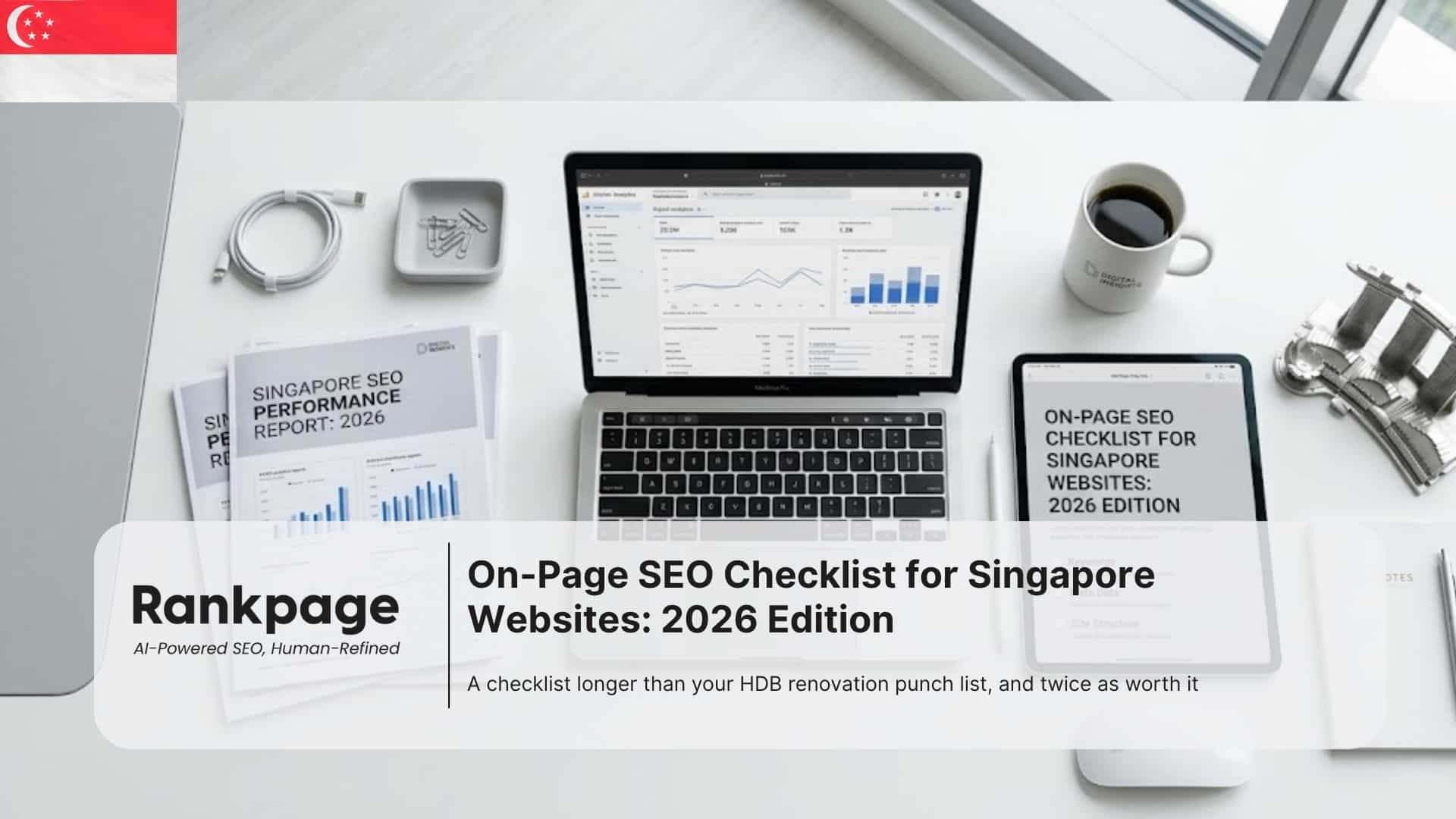
If you want your Singapore website to rank higher on Google, and increasingly, to appear in AI-generated search answers, on-page SEO is where the work begins.
Unlike off-page signals like backlinks, on-page SEO covers everything within your direct control: your content, your page structure, your meta tags, your internal links, and the technical signals your pages send to search engines.
This checklist covers every key on-page element Singapore businesses need to get right in 2026.
Key Takeaways
On-page SEO essentials for Singapore websites in 2026:
- Every page needs a unique, keyword-optimised title tag and meta description under the character limits.
- Content must fully address search intent, not just include the target keyword.
- Schema markup is frequently missed and provides a direct advantage in both traditional and AI search.
- Internal linking strategy is as important as content quality for topical authority.
- In 2026, on-page SEO must be optimised for AI search surfaces, not just Google’s blue links.
What Is On-Page SEO?
On-page SEO refers to all optimisation work done directly on your website pages to improve their visibility in search results. It encompasses both the content your users read and the code signals your pages send to search engine crawlers.
Strong on-page SEO is the foundation that makes every other marketing effort more effective. Without it, even the best content and backlink strategy will underperform.
The Complete On-Page SEO Checklist for Singapore Websites
Title Tags
- [ ] Every page has a unique title tag (under 60 characters)
- [ ] The primary target keyword appears in the title tag, ideally near the start
- [ ] Title tags are written to be compelling to click, not just keyword-dense
- [ ] Location (Singapore) is included where relevant for local queries
Meta Descriptions
- [ ] Every page has a unique meta description (under 160 characters)
- [ ] The meta description includes the target keyword naturally
- [ ] It includes a clear value proposition or call to action
- [ ] It reads as compelling copy, not just a summary
Headings (H1, H2, H3)
- [ ] Each page has exactly one H1 tag containing the primary keyword
- [ ] H2 and H3 subheadings are used to organise content logically
- [ ] Subheadings include secondary keywords and related terms naturally
- [ ] At least one H2 mirrors a common user question related to the topic
Content Quality
- [ ] Content fully addresses the search intent behind the target keyword
- [ ] The primary keyword appears naturally in the first 100 words
- [ ] Related keywords and synonyms are used throughout, avoid keyword stuffing
- [ ] Content is at least 800 words for informational pages; more for competitive queries
- [ ] Content is original, accurate, and provides genuine value
- [ ] Statistics and facts are sourced and linked to credible references
URL Structure
- [ ] URLs are short, descriptive, and include the target keyword
- [ ] No unnecessary parameters, numbers, or special characters
- [ ] Words are separated by hyphens (not underscores)
- [ ] Singapore-relevant URLs include location context where appropriate
Images and Media
- [ ] All images have descriptive, keyword-relevant alt text
- [ ] Image file names are descriptive (not IMG_1234.jpg)
- [ ] Images are compressed for fast loading
- [ ] Videos (if used) have descriptive titles and transcripts
Internal Linking
- [ ] Each page includes at least 2–3 internal links to related pages
- [ ] Anchor text is descriptive and keyword-relevant (not “click here”)
- [ ] Important service pages receive internal links from relevant blog posts
- [ ] No orphan pages, every page is reachable through internal navigation
Schema Markup
- [ ] Appropriate schema type is implemented (Article, FAQPage, LocalBusiness, Service, etc.)
- [ ] FAQ schema is added to pages with question-and-answer sections
- [ ] LocalBusiness schema includes complete NAP data for Singapore pages
- [ ] Schema is validated using Google’s Rich Results Test
Validate any structured data you add using Google’s Rich Results Test.
Page Experience
- [ ] Page loads in under 3 seconds on mobile
- [ ] Core Web Vitals pass: LCP, INP, and CLS within Google’s thresholds
- [ ] Page is fully functional on mobile devices
- [ ] No intrusive interstitials or pop-ups that block content
E-E-A-T Signals
- [ ] Author is credited with a bio demonstrating relevant expertise
- [ ] Content references credible, up-to-date sources
- [ ] Business contact information, address, and credentials are clearly displayed
- [ ] Customer reviews or case studies support claims made
Most Commonly Missed On-Page SEO Elements in Singapore
Based on common patterns among Singapore business websites, these are the elements most frequently overlooked:
- Schema markup: Most Singapore SME websites have zero structured data, missing easy opportunities for rich results and AI citation eligibility.
We cover this in detail in our schema markup guide for Singapore businesses.
- Internal linking: Service pages often sit as isolated islands with no links flowing between them, weakening topical authority.
Our internal linking strategy guide shows how to connect your pages for maximum effect.
- Mobile content parity: Some Singapore websites show different content on mobile and desktop, creating indexation inconsistencies.
- Keyword cannibalisation: Multiple pages targeting the same keyword compete against each other, diluting ranking potential.
You can monitor indexation and page experience for free in Google Search Console.
Our SEO services in Singapore include a full on-page audit that identifies and fixes these issues systematically.
Two of the most important on-page elements deserve their own read: how to write title tags and meta descriptions and E-E-A-T explained.
On-Page SEO for AI Search in 2026
In 2026, on-page SEO must account for AI search surfaces, not just Google’s traditional results. This means:
- Writing content that opens with a direct, extractable answer to the target query
- Structuring pages so AI systems can parse sections independently
- Including FAQ sections with schema markup so AI tools can surface your answers directly
Technical SEO and AI SEO services work together with on-page optimisation to ensure your website performs across all search surfaces.
Frequently Asked Questions
How often should I update on-page SEO?
Review your key pages at least quarterly. Update content to reflect current information, refresh statistics, and ensure alignment with the latest search intent patterns.
What is the most important on-page SEO element?
Content quality and search intent alignment are the most important. Without content that genuinely addresses what the user is looking for, no amount of technical optimisation will deliver strong rankings.
Can I do on-page SEO myself?
Yes, the checklist above gives you a solid framework. For a comprehensive audit and implementation, Rankpage’s on-page SEO services Singapore can identify and fix issues systematically across your entire site.
How long does on-page SEO take to show results?
Most Singapore websites see movement within a few weeks to a couple of months after fixing on-page issues, though competitive keywords can take longer. On-page changes are typically the fastest-acting part of an SEO strategy.
Does on-page SEO matter for AI search too?
Yes. Clear structure, direct answers, question-based headings, and schema markup all help AI systems parse and cite your content, so strong on-page SEO supports both traditional rankings and AI search visibility.
As a leading best SEO agency, Rankpage helps businesses turn these strategies into measurable results.
Rankpage Singapore, On-page SEO and AI search optimisation for Singapore businesses. Visit rankpage.com.sg.