How Is Voice and Conversational Search Different?
Traditional Search Phrase | Conversational Search Query |
Voice search SEO Singapore | How do I optimise my website for voice search in Singapore? |
Office cleaning price | How much does office cleaning cost per month in Singapore? |
Best CRM SME | Which CRM is suitable for a small Singapore business? |
Aircon servicing Tampines | Where can I get aircon servicing near Tampines today? |
Conversational queries are often longer because they may include location, budget, urgency or business type.
Someone searching “accounting software” could mean almost anything, while someone asking “ accounting software for Singapore e-invoicing” has expressed a clearer need.
Voice queries may also involve local or immediate needs, such as finding a nearby business or checking opening hours.
However, voice and conversational search are not separate SEO channels. Both still depend on strong technical SEO, useful content, clear structure and accurate business information.
What Are Question-Based Keywords?
Question-based keywords are queries framed as complete or implied questions, often beginning with what, how, which, where, why or can.
For example, “corporate secretary Singapore” is broad. “Do I need a corporate secretary before registering a company in Singapore?” identifies a specific concern and creates an opportunity to give a direct answer.
Question keywords can be found through Search Console, customer enquiries, sales conversations, autocomplete suggestions and internal site search data.
Several differently phrased questions may represent the same intent and should usually be answered on one strong page rather than split across thin articles.
How Do Singaporeans Phrase Spoken Queries?
Singapore search behaviour reflects the country’s geography, industries and everyday vocabulary.
Users may include neighbourhoods, MRT stations or business districts:
- “Where can I print name cards near Tai Seng?”
- “Which tuition centre is close to Bishan MRT?”
- “Is there an affordable office mover in the CBD?”
Searches may also use abbreviations such as SME, HDB, BTO, COE, CPF, GST, MOM and IRAS.
Conversational searches may include local phrasing, but businesses should avoid forcing Singlish. The better approach is to reflect how customers genuinely describe their needs.
For instance, many customers are more likely to ask, “How often should I service my aircon in Singapore?” than use a formal phrase such as “air-conditioning maintenance provider”.
Singapore has four official languages: English, Malay, Mandarin and Tamil. Businesses serving multilingual users should research each target language rather than rely only on literal translations.
How Does Conversational Search Tie Into AEO and AI?
Answer engine optimisation, or AEO, focuses on making content easier for search and AI systems to interpret and present as an answer. To put it simply, AEO services essentially make your content more discoverable by AI.
Google may respond to a detailed query through a standard result, featured snippet, AI Overview or AI Mode response. The same question may also be asked through an AI assistant.
Google’s guidance states that its generative AI search features remain rooted in existing Search ranking and quality systems. Pages must still be accessible to Google and eligible to appear in Search. There is no shortcut that replaces foundational SEO.
A page is easier to use in answer-driven results when it:
Answers first: Place a concise response below the heading.
Explains properly: Add context, examples and limitations.
Uses clear entities: Identify the company, service, location, product or regulation.
Demonstrates experience: Include practical examples and first-hand observations.
Maintains consistency: Keep business information aligned across the website and external profiles.
Structured data may support search understanding and rich-result eligibility, but it does not replace clear content. Google also states that no special schema is required purely for generative AI features.
What Content Format Suits Conversational Search?
There is no single format that wins every conversational query. The format should match the answer.
A definition may work best as a short paragraph, a process may need numbered steps, a comparison may be clearer in a table, and a local query may require service areas and opening hours.
A practical structure is:
- Use a specific, question-based heading.
- Answer in one or two sentences.
- Add conditions that may change the answer.
- Provide a local example.
- Link to the next useful page or action.
FAQs can support conversational visibility, but they should answer genuine follow-up questions. The main body should still do most of the work.
How Can Singapore Businesses Optimise for Voice Search SEO?
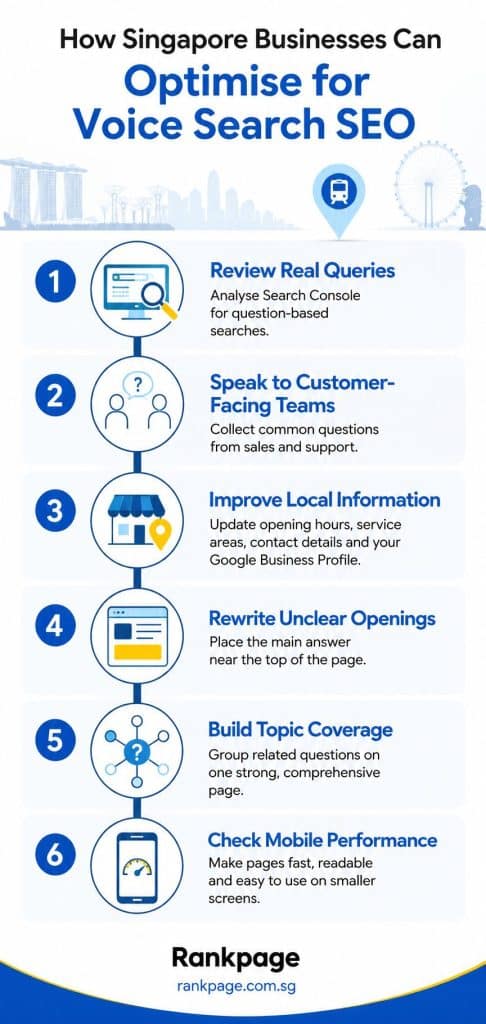
Start with pages that already receive impressions and enquiries.
Review real queries: Check Search Console for longer searches containing words such as how, what, where, can, should and which.
Speak to customer-facing teams: Sales and support staff often hear questions that keyword tools overlook.
Improve local information: Maintain accurate opening hours, service areas, contact details and Google Business Profile information.
Rewrite unclear openings: Place the main answer earlier.
Build topic coverage: Answer related questions on the same page when they share a common intent.
Check mobile performance: Make sure pages are fast, readable and easy to use on smaller screens.
Reading key sections aloud can also help. If a sentence is difficult to say or understand, it may be unnecessarily complicated.
Read More: AEO vs SEO vs GEO: The Differences Every Singapore Brand Must Understand
Does Voice Search Still Matter in 2026?
Voice-oriented optimisation remains relevant in 2026, but it is most useful as part of the broader shift towards natural-language and conversational search.
The bigger development is the wider use of natural-language interaction across mobile search, AI Mode and generative assistants. Users can ask follow-up questions, add context and refine their requests conversationally. Google’s AI Mode accepts questions through text, voice or images and allows users to continue exploring a topic through follow-ups.
This means “voice SEO” can be too narrow. A page written to answer a spoken question may also be useful when the same question is typed or submitted to an AI system.
Singapore businesses should therefore focus on conversational intent rather than trying to predict whether every query will be spoken.
The useful question is not, “How do we rank on a smart speaker?”, but “Can our website clearly answer the questions customers ask in full sentences?”
Make Your Content Easier to Ask and Answer
Optimising for voice and conversational search is about making content sound more like a helpful response and less like a collection of keywords.
Singapore businesses should pay attention to the local terms, locations and practical concerns customers include in their searches. Answer clearly, provide useful detail and make the next step easy.
Rankpage, your trusted Singapore SEO consultant, helps Singapore businesses build an SEO strategy around real search intent, stronger content and visibility across traditional and AI-driven search. Talk to us to learn more.
Sources
- Google Search Central, “AI Features and Your Website”
- Google Search Central, “Google’s Guide to Optimizing for Generative AI Features”
- Google Search Central, “Creating Helpful, Reliable, People-First Content”
- Google Search Central, “SEO Starter Guide”
- Google Search Help, “Get AI-Powered Responses With AI Mode”
- Google Search Central, “Introduction to Structured Data Markup”
- Google Search Central, “Changes to HowTo and FAQ Rich Results”
- Singapore Statutes Online, “Republic of Singapore Independence Act 1965”