What Is Entity SEO?
Entity SEO focuses on making a business, person, place or concept easier for search systems to identify and distinguish.
For example, “SEO agency Singapore” is a keyword.
“Rankpage”, on the other hand, is an organisation connected to particular services, markets, people and topics.
Entity optimisation aims to make those relationships clearer.
This does not replace keyword SEO. Pages still need to target relevant searches, satisfy intent and be technically accessible.
Entity SEO adds another layer by helping search systems understand who or what the content is about.
What Is the Knowledge Graph?
A knowledge graph organises information around entities and their relationships.
For example:
- Company
- Provides
- SEO Services
- Operates In
- Singapore
Modern search systems do more than match words. They also interpret meaning, context and connections between people, organisations, places and topics.
Google uses structured information about organisations to better understand business details and distinguish one organisation from another.
However, entity SEO does not guarantee a Knowledge Panel or automatic inclusion in Google’s Knowledge Graph.
The practical goal is simpler: make your business identity clear, consistent and easy to verify across credible sources.
How Does Google Build a Brand Entity?
Google does not publish a fixed checklist for becoming a recognised brand entity.
Its Knowledge Graph and business information can draw on multiple public and first-party sources, including:
- Official Websites
- Organization Structured Data
- Google Business Profiles
- Relevant Business Directories
- Social And Professional Profiles
- Credible Third-Party Coverage
Consistency is useful because it reduces conflicting information about the business.
If a company uses the same name, description and service information across its website, profiles and credible external references, the public picture is clearer.
If those sources contain conflicting or outdated information, the business identity becomes less consistent.
Entity optimisation is partly about reducing that ambiguity.
Why Do Entities Matter for AI Citation?
Some AI search systems retrieve web information before generating an answer.
Clear, retrievable information about a brand can make it easier for these systems to identify relevant sources about the company. However, AI providers do not publish a universal entity-recognition requirement for brand mentions or citations.
If a cybersecurity firm is consistently described across its website, profiles and industry coverage as a Singapore cybersecurity provider, those sources create a clearer public description of the relationship between the company and that topic.
That does not mean strong entity SEO guarantees a ChatGPT, Gemini or AI Overview citation.
Citation can vary with the query, available information and the sources retrieved. OpenAI, for example, describes ChatGPT Search as providing timely answers with links to relevant web sources, but does not publish a complete citation-ranking formula.
What Information Can Help Clarify a Brand Entity?
A clear brand identity usually comes from several pieces of information working together.
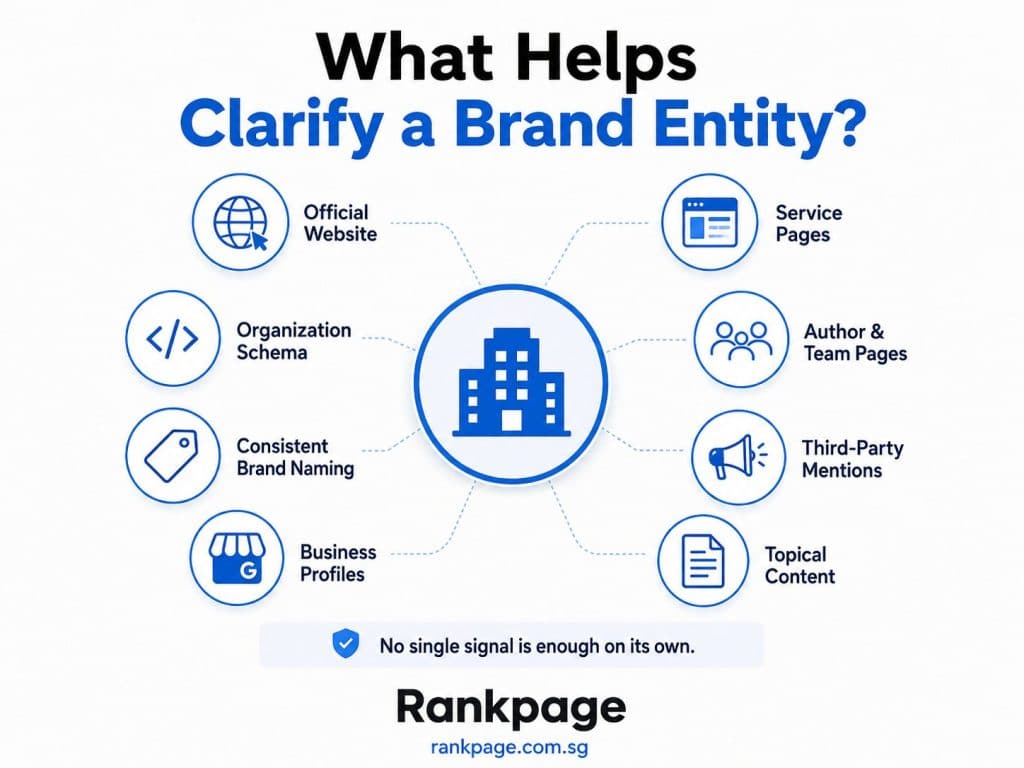
No single item is enough on its own.
Schema can help machines interpret information, but it should accurately describe information supported by the website.
Backlinks remain important in traditional SEO, while relevant third-party mentions can provide additional context about what a company does.
Google does not publish a simple formula comparing the entity value of unlinked mentions with backlinks.
Read More: E-E-A-T Explained: How Google Judges Your Singapore Website’s Content Quality
How Do I Strengthen My Brand Entity?
Establish One Clear Brand Identity
Use consistent information for your company name, website, location, logo, services and business description.
Extend that consistency to major external profiles and review outdated references if the business has changed names, services or locations.
Strengthen Your About Page
Your About page should clearly explain what the business does, where it operates and what it is known for.
Avoid generic wording. Instead of saying a business “provides innovative solutions”, explain what those solutions are and who they are for.
Specific information is easier for both users and search systems to interpret.
Use Appropriate Structured Data
Organization or LocalBusiness schema can communicate company information in a machine-readable format.
Schema should describe the business accurately rather than trying to manufacture authority. Adding more markup does not automatically make an entity stronger.
Build Relevant External Mentions
Third-party mentions can provide independent context about how the wider web describes your company.
For a Singapore business, a relevant mention in an industry publication, association website or credible directory may be more useful for brand clarity than many unrelated references.
If a company is regularly described alongside the same industry, service or expertise, that creates a more consistent public description of what it does.
This should not be confused with a confirmed Google ranking formula.
Connect Your People, Services and Expertise
Founders, authors, specialists, services and locations can provide useful context about the organisation.
If a subject matter expert regularly writes about a topic, it should be clear who that person is, what organisation they belong to and why they are qualified to discuss it.
Is Entity SEO Replacing Traditional SEO?
No.
Entity SEO works alongside technical SEO, content optimisation, internal linking, backlinks and keyword targeting.
Businesses now need to think beyond:
“Where does this page rank?”
They also need to consider:
“What do search engines and AI-powered systems understand about our brand?”
Building a clear relationship between a brand and the topics it genuinely specialises in is a broader, longer-term objective.
Using Entity SEO Well
Entity SEO is ultimately about making your brand easier to understand.
Clear business information, structured data, consistent profiles, relevant content and credible third-party mentions can provide search engines with a more coherent picture of who you are and what you do.
A clear public identity also gives search-based AI systems better information to work with, although it does not guarantee recommendations, mentions or citations.
At Rankpage, your reliable SEO digital marketing agency in Singapore, we incorporate entity optimisation into our wider SEO approach, combining technical improvements, structured data, content and external signals.
For Singapore businesses looking to strengthen visibility across traditional and AI-powered search, building a clearer brand identity is a strong foundation.
Sources
- Google Search Central, Organization Structured Data
- Google Search Central, Introduction to Structured Data
- Google Search Central, LocalBusiness Structured Data
- Google Search Central, Establish Your Business Details With Google
- Google, How Google’s Knowledge Graph Works
- Schema.org, sameAs Property
- OpenAI, Introducing ChatGPT Search