
How Is eCommerce SEO Different From Normal SEO?
Online stores can generate thousands of URLs through products, categories, filters and variants.
That creates different priorities from a typical corporate website.
Standard Website SEO | eCommerce SEO |
Mainly service and informational pages | Categories, products and filters |
Relatively stable URLs | Inventory changes frequently |
Limited duplicate content | Variants can create near-duplicates |
Smaller site architecture | Often several levels deep |
Conversion often means an enquiry | Conversion happens online |
Structured data is useful | Product data affects shopping visibility |
For ecommerce SEO, three questions matter:
- Can search engines find the right pages? This depends on crawlability, internal linking, sitemaps and URL structure.
- Can search engines understand the products? This depends on titles, descriptions, specifications, schema and product feeds.
- Can shoppers confidently buy? Price, stock, delivery, reviews, returns and payment options all matter.
Category vs Product Pages: Which Matters More?
For most ecommerce stores, category pages should target broader commercial searches, while product pages should target specific products, models and attributes.
A category page might target:
“Ergonomic office chair Singapore”
A product page might target:
“ErgoFlex X2 mesh office chair”
The first reflects broader comparison intent. The second is more product-specific.
Category pages often provide the larger scalable SEO opportunity because one page can target a core term, related product types, brands, features and buying considerations.
That does not mean adding huge blocks of copy. A short introduction, useful filters, strong product cards and supporting content are usually enough.
When Should Product Pages Be the Priority?
Product pages are especially useful for searches involving:
- Brands
- Models
- Specifications
- Materials
- Use cases
- Specific attributes
The key is not to assume every SKU deserves an SEO landing page simply because it exists.
How Do Singapore Shoppers Search for Products?
Singapore ecommerce journeys often involve several platforms.
A shopper might discover a product on TikTok, compare prices on Shopee or Lazada, search it on Google and then visit the brand website before buying.
Google research found that 75% of surveyed Singapore shoppers had used Google to search, explore or evaluate products from brands.
That means your website does not have to replace marketplaces. It needs to be a strong source of product information while customers decide what to buy.
For Singapore stores, make the following obvious:
Pricing: Display SGD clearly.
Delivery: State local fees, delivery times and free-shipping thresholds.
Availability: Keep stock information accurate.
Payments: Show relevant options. PayNow enables participating consumers and businesses to send and receive SGD instantly through participating financial institutions.
Returns: Explain the return window and conditions clearly.
Local trust: Include legitimate business information, support details, warranties and reviews.
Google also supports structured information for shipping and return policies in eligible product experiences.
How Should You Optimise Category Pages?
Treat each important category as a search landing page, not just a navigation page.
For example:
/hair-care/
is usually more durable than a temporary marketing URL such as:
/collections/shop-all-hair-products-sale-2026/
Category optimisation should include:
Title Tag: Use the main category term.
H1: Clearly describe the products.
Introductory Copy: Confirm relevance quickly.
Product Selection: Show relevant products prominently.
Internal Links: Link to useful subcategories and buying guides.
Supporting Content: Answer key buying questions without overwhelming the page.
A running-shoe category could link to trail shoes, road shoes, stability shoes and a buying guide.
How Should Product Pages Be Optimised?
Good product SEO is less about keyword repetition and more about making the product easy to understand.
A strong product page should usually include:
- Descriptive product name
- Original copy
- Specifications
- High-quality images
- Price
- Availability
- Shipping
- Returns
- Reviews
Avoid relying entirely on manufacturer descriptions.
Instead, add useful details such as dimensions, capacity, materials, compatibility, intended use and care instructions.
That helps both traditional search and AI systems understand the product more accurately.
How Do I Handle Duplicate and Variant Content?
Variants are a major ecommerce SEO risk.
A T-shirt with five colours and six sizes could generate 30 URLs for one core product. If a size change simply switches “M” to “L”, you generally do not need a separately optimised SEO page.
Some variants may justify separate URLs when they have meaningful standalone demand, such as different phone storage capacities.
Google supports both single-page and multi-page variant implementations and provides guidance using ProductGroup, Product, variesBy and hasVariant.
From an SEO perspective, give a variant its own indexable page when it has meaningful search value, not simply because your platform generated another URL.
Filters need similar control.
URLs such as:
/shoes?colour=black&size=8&brand=x&sort=price-low
can multiply quickly.
Only allow filtered combinations to become search landing pages when they serve genuine search demand.
What Technical SEO Problems Hurt Store Rankings?
Common ecommerce problems include:
Crawl Waste: Endless filter and parameter combinations.
Orphan Products: Products with little internal linking.
Deep Architecture: Important pages buried too many clicks deep.
Discontinued URLs: Product pages removed unnecessarily.
Redirect Chains: Multiple redirects after migrations or category changes.
JavaScript Dependence: Important product data only available after rendering.
Slow Templates: Large images, apps and tracking scripts.
Google recommends placing Product structured data in the initial HTML when optimising for shopping results, especially for fast-changing information such as price and availability.
For large stores, technical hygiene affects how efficiently search engines discover revenue-generating pages.
What Schema Do eCommerce Stores Need?
Stores should pay particular attention to Product and Offer structured data.
Useful schema can include:
Schema Type | Purpose |
Product | Describes the product |
Offer | Price, currency and availability |
ProductGroup | Connects variants |
AggregateRating | Aggregated ratings |
Review | Eligible reviews |
BreadcrumbList | Page hierarchy |
Organization | Business information |
MerchantReturnPolicy | Return policies |
ShippingService | Shipping policies |
Do not add schema simply because a plugin offers it.
The markup should reflect accurate information on the page.
Price, availability and identifiers should also remain consistent across the website and Merchant Center.
Shopify and WooCommerce SEO
Both platforms can support strong SEO, but each has technical risks.
For Shopify SEO services, focus on:
- Collection architecture
- Internal linking
- Canonical behaviour
- Product schema
- Theme performance
- Unnecessary apps
For WooCommerce SEO services, review:
- Categories, tags and attributes
- Filter parameters
- Plugin performance
- Conflicting structured data
- Pagination
- Internal search URLs
The goal is the same on both platforms: stop useful merchandising features from creating unnecessary search-engine clutter.
How Does Google Merchant Center Fit Into eCommerce SEO?
Merchant Center should be treated as part of the product-discovery ecosystem, not only as an advertising platform.
Google can discover product information from websites, while Merchant Center gives merchants more control over product data.
Google’s 2026 Merchant Center product specification introduced additional shipping attributes, including handling cutoff times and minimum order values.
Singapore merchants should keep these aligned between the website and Merchant Center:
- Titles
- Descriptions
- Product identifiers
- SGD prices
- Availability
- Images
- Shipping
- Returns
Website SEO and feeds should not operate as separate projects.
How Does AI Product Discovery Change eCommerce SEO?
AI-powered shopping queries can be much more detailed than traditional searches.
Instead of:
“best running shoes Singapore”
a shopper might ask:
“What are good lightweight running shoes under S$180 for wide feet?”
To answer that, an AI system needs clear data about price, width, weight, intended use, reviews and availability. Google’s 2026 guidance says generative AI features continue to rely on core Search ranking and quality systems, so traditional SEO remains foundational.
Merchant Center also supports optional conversational attributes, including Q&A data, document links, related products, item-group titles and variant information. Google has introduced AI Performance Insights to help participating merchants understand how products appear across conversational shopping journeys.
As of September 2026, the feature is being piloted with selected US Merchant Center accounts. Google says Australia, Canada, India and New Zealand are next; Singapore is not currently listed.
The practical lesson is simple: describe the attributes that determine whether a product is the right choice, not just its name.
What Helps Products Get Found in AI Search?
There is no magic “AI SEO schema” that guarantees recommendations.
Instead:
Make product information explicit: State measurable details such as weight, size and compatibility.
Make comparisons easy: Explain clearly how similar products differ.
Keep commercial information accurate: Price, stock, shipping and returns should agree across the page, schema and feed.
Create unique information: Useful examples include comparison tables, sizing advice, compatibility notes, product testing and buyer FAQs.
AI discovery does not replace ecommerce SEO. It increases the value of accurate and detailed product information.
How Can Singapore Stores Compete With Shopee, Lazada and Larger Retailers?
Trying to outrank large marketplaces for every generic product keyword is rarely the best strategy.
Independent stores can compete through relevance and expertise.
A specialist retailer can publish stronger category content, buying guides, comparisons, FAQs and product advice.
A coffee-equipment store, for example, can focus on becoming a highly relevant Singapore resource for grinders, espresso machines and brewing equipment.
Marketplaces win through scale.
Specialist stores can win through depth and information quality.
What Should an eCommerce SEO Strategy Prioritise in 2026?
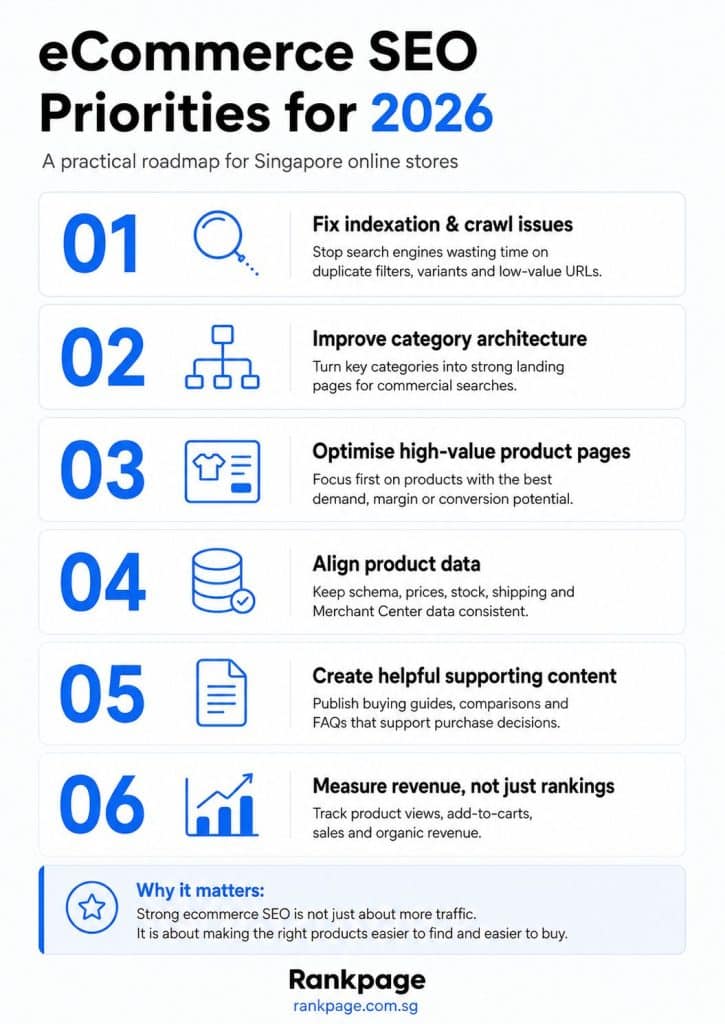
For most Singapore online stores:
- First, fix indexation and crawl problems.
- Second, improve category architecture.
- Third, improve high-value product pages.
- Fourth, align structured data, Merchant Center, pricing and availability.
- Fifth, create useful buying guides and comparisons.
- Finally, measure revenue rather than rankings alone.
A ranking improvement is useful, but the bigger question is whether organic search produces more product views, add-to-carts, transactions and revenue.
Understanding eCommerce SEO in Singapore
eCommerce SEO in Singapore in 2026 requires more than optimising product titles.
The strongest stores connect category strategy, product SEO, technical foundations, structured data, Merchant Center and AI-powered product discovery.
If your store is struggling with organic visibility, Rankpage is a SEO agency in Singapore that can help identify where technical issues, category structure or product optimisation may be holding it back. Our SEO services can help Singapore ecommerce businesses strengthen their search foundations while preparing for how customers discover and compare products today.