How Do I Write a Product Description That Ranks?
A product description should explain the product in language shoppers understand while naturally covering important attributes and use cases.
Instead of naming an office chair simply ‘RX900′
use something more descriptive like ‘RX900 Ergonomic Mesh Office Chair With Adjustable Lumbar Support’
The description can then cover what matters without repeating the keyword:
Designed for long hours at a desk, the RX900 combines breathable mesh with adjustable lumbar support, a height-adjustable headrest and 4D armrests.
There is no need to mention “ergonomic office chair Singapore” repeatedly.
Instead, naturally cover materials, dimensions, compatibility, benefits, intended users, care requirements, warranty and what is included.
Read More: eCommerce SEO in Singapore: The Complete 2026 Guide
Where Should Product Page Keywords Go?
The main keyword should appear where it accurately describes the product, rather than being forced into every section.
Page Element | What to Optimise |
Product H1 | Product type, model and differentiator |
Title tag | Main product term and relevant context |
Opening copy | Direct explanation of the product |
Specifications | Materials, sizes and attributes |
Image alt text | What the image genuinely shows |
Internal links | Relevant category terminology |
Structured data | Matching factual product information |
For Shopify businesses, this is why Shopify SEO services should go beyond rewriting title tags.
Organic visibility can also be affected by collection architecture, internal links, variants, canonicalisation, faceted navigation, structured data and product-feed quality.
Good copy cannot compensate for a messy technical setup indefinitely.
What Product Schema Do I Need?
For an eCommerce page where customers can buy the product, Product structured data with merchant-listing information is generally the relevant setup.
It can communicate:
Core details: Name, description, image, SKU, brand, GTIN or MPN.
Offer information: Price, currency, availability, condition and purchase URL.
Additional information: Ratings, shipping and returns where applicable.
If products have variants, Google also supports ProductGroup markup for relationships between options such as sizes and colours.
Structured data does not automatically improve rankings, and Google does not guarantee rich results simply because markup is present. Its value is helping Google understand the product and making eligible pages available for enhanced search experiences.
How Many Words Should a Product Page Have?
There is no ideal product-page word count.
A S$15 charging cable may need little explanation. A S$3,000 massage chair probably needs much more.
Instead of asking how long the page should be, ask “What does the shopper need to know before choosing this product?”
Simple products may only need specifications, compatibility, delivery, warranty and a short description. Higher-consideration products may need comparisons, measurements, demonstrations, FAQs and detailed benefits.
How Do Reviews Affect Ranking and AI?
Reviews strengthen product pages because customers often describe products differently from brands. A manufacturer might say a backpack uses water-resistant fabric. Customers may say it handled a Singapore downpour or comfortably fits a 16-inch laptop. That adds real-world context that polished product copy often misses.
Reviews also provide social proof, while eligible aggregate ratings may be represented through Product structured data.
However, more reviews do not automatically equal higher rankings. Their practical value comes from making the page richer and more useful, especially for conversational searches.
How Do I Avoid Thin or Duplicate Product Pages?
A catalogue of 5,000 products cannot always receive 5,000 hand-written essays.
The solution is deciding where unique optimisation matters most.
Priority products: Give high-demand, high-margin or strategic products stronger descriptions, FAQs, images and comparisons.
Standard products: Use a consistent template with unique attributes and specifications.
Long-tail inventory: Keep information accurate without manufacturing unnecessary copy solely for SEO.
Variants need similar judgement.
A different SKU does not automatically need a separate indexable page. If only the size changes, keeping variants together may make more sense. If specifications, uses or search demand differ substantially, a separate URL may be justified.
This is where an ecommerce SEO service becomes technical as much as editorial. Canonicalisation, variant handling, filtering and URL generation can create large numbers of weak pages.
How Can Product Pages Rank Without Hurting Conversions?
Product SEO should support the purchase journey rather than interrupt it.
Put the most decision-critical information near the top:
- Product name
- Strong product imagery
- Price
- Primary benefit
- Variant selection
- Availability
- Delivery information
- Add-to-cart action
Then add specifications, FAQs, sizing guidance, reviews and related content further down.
This avoids the common “SEO wall of text” underneath the product title.
At Rankpage, one pattern we often see is that the strongest product pages do not look aggressively optimised.
They simply look complete.
How Do Products Get Surfaced by AI?
There is no single AI SEO tag that makes ChatGPT, Google AI Mode or another AI system recommend a product.
Visibility depends on whether systems can clearly identify the product, understand its attributes and connect it with a user’s need.
Merchant Center now includes optional conversational attributes designed to give AI systems more product context. Google currently lists question and answer, document link, related product and item group title as conversational attributes. Separate variant attributes can also help clarify product variations.
Google also says its product_detail and product_highlight attributes can support product discovery across AI-driven experiences such as AI Mode.
In May 2026, Google announced AI performance insights in Merchant Center, including visibility data for AI Mode and AI Overviews.
However, availability remains limited. As of September 2026, Google says the feature is being piloted with a limited number of Merchant Center accounts in the US, with expansion announced for Australia, Canada, India and New Zealand.
For Singapore eCommerce businesses, the broader direction is still worth watching even though this reporting feature is not currently listed as available in Singapore.
AI product optimisation increasingly looks like:
Clear product copy + accurate specifications + structured data + strong feeds + reviews + consistent brand information.
Instead of asking, “Did we use the keyword?”, ask whether a machine can confidently understand when your product is relevant.
What Product Information Should Stay Consistent?
Your website, schema and product feed should describe the same product.
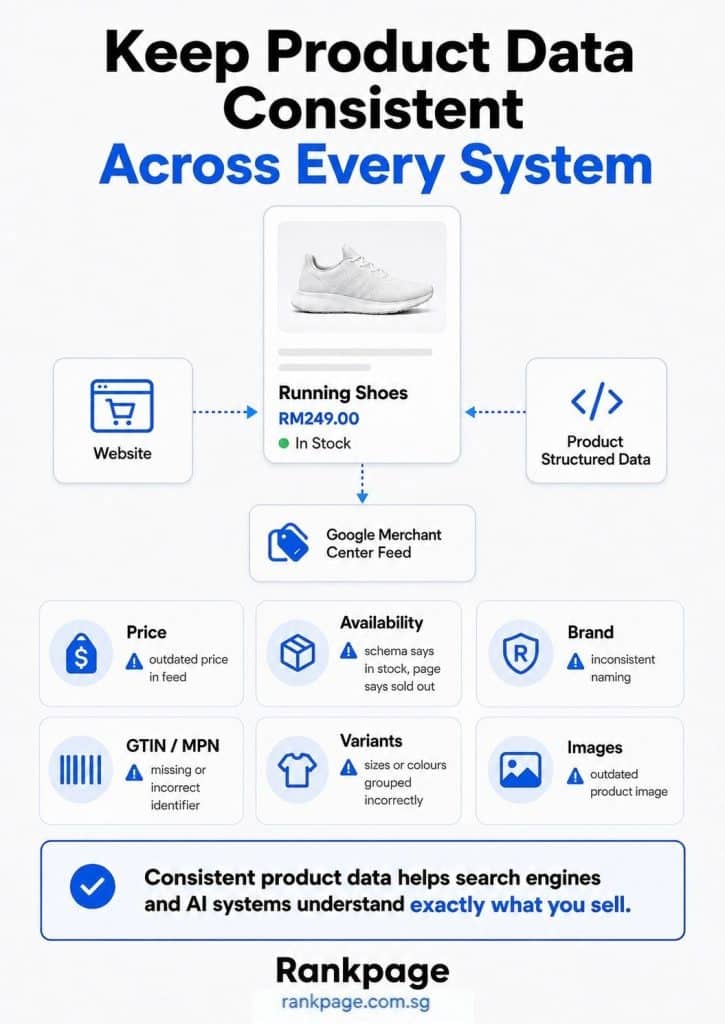
This is easy to overlook when Shopify stores use several apps and integrations.
Product SEO works better when those systems agree.
Improving Your Product Page SEO
Product page SEO that ranks and converts comes down to making products easier to understand. Shoppers should quickly see why a product suits them, while search engines and AI systems receive accurate content, attributes and structured information.
If your eCommerce store has strong products but weak organic visibility, and you’re trying to decide on the best SEO agency in Singapore that suits your needs, Rankpage can help connect content, technical SEO and product data into a more complete search strategy. Our SEO and Shopify SEO services are built around improving discoverability without sacrificing the shopping experience that turns traffic into revenue.
Sources
- Google Search Central, Product Structured Data
- Google Search Central, Merchant Listing Structured Data
- Google Search Central, Product Variant Structured Data
- Google Search Central, Creating Helpful, Reliable, People-First Content
- Google Search Central, Canonicalisation
- Google Search Central, Review Snippet Structured Data
- Google Merchant Center Help, Product Data Specification
- Google Merchant Center Help, How to Use Conversational Attributes
- Google Merchant Center Help, Question and Answer Attribute
- Google Merchant Center Help, Variant Option Attribute
- Google Merchant Center Help, Product Highlight Attribute
- Google Merchant Center Help, Product Detail Attribute
- Google Merchant Center Help, AI Performance Insights