What Makes AI Trust a Source?
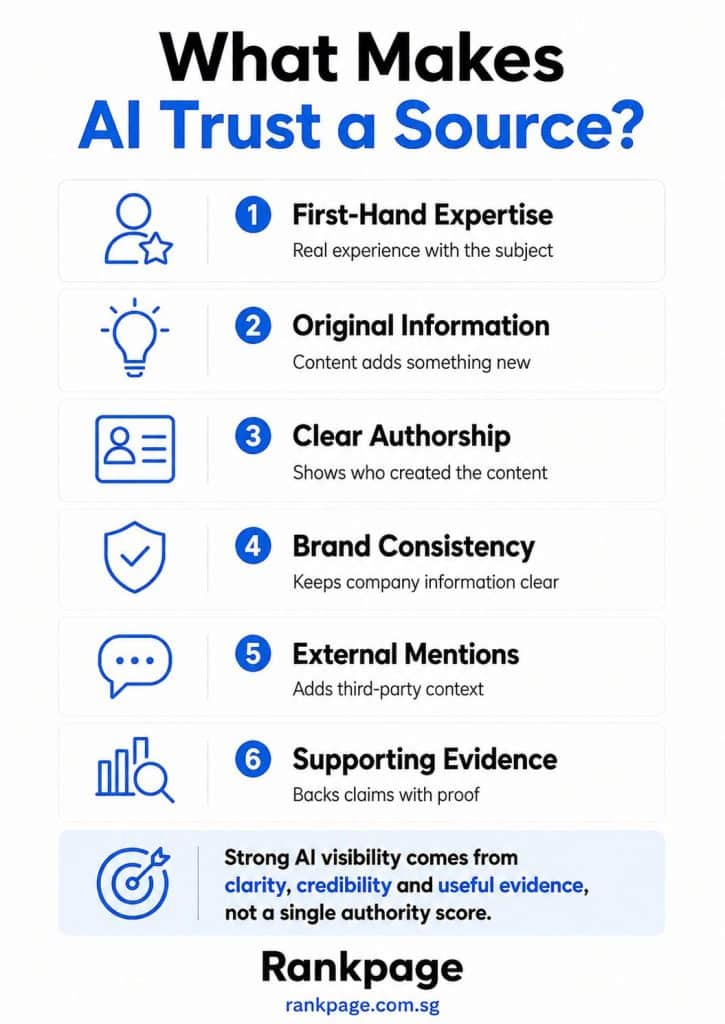
There is no single public “AI authority score” that determines which websites get cited.
Different AI systems retrieve and use information differently. For Google’s AI search features, established SEO fundamentals such as accessibility, relevance and helpful, reliable content still matter.
Corroboration can strengthen credibility, but it is better treated as a practical trust principle than as a disclosed AI citation factor.
If your website says you specialise in enterprise SEO, your case studies demonstrate that work, your team publishes useful insights and credible external sources also associate your brand with SEO, the overall picture becomes clearer.
How Is AI Trust Different From Google Rankings?
AI citations and traditional rankings overlap, but they are not the same outcome.
Traditional SEO asks whether a page should rank for a query. AI search may also use a page because it contains information useful enough to support part of a generated answer.
Traditional SEO | AI Authority |
Can the page rank? | Is it worth referencing? |
Does it satisfy intent? | Does it contain extractable answers? |
Is the site authoritative? | Is the specific claim credible? |
Can Google understand it? | Can the source be understood clearly? |
This is why we see AI SEO services as an extension of strong SEO rather than a completely separate discipline.
The fundamentals still matter. The difference is that content also needs to become useful as a source.
Do Credentials and Authorship Matter?
Yes, especially for topics where expertise matters.
Clear authorship helps users understand who produced the information and why that person may be qualified to discuss it. Useful signals include a named author, relevant experience, supporting evidence and a clear relationship with the publishing organisation.
This is where Google’s E-E-A-T framework can be a useful quality lens.
E-E-A-T should not be treated as a published scoring system for AI citations, and Google states that E-E-A-T itself is not one specific ranking factor.
Adding an author box to generic content does not create expertise. The content itself still needs to demonstrate it.
How Do Consistent Mentions Build Trust?
Consistent, accurate brand information can reduce ambiguity for users and search systems.
Google, for example, says organisation structured data can help it understand and disambiguate an organisation.
Your company name, services, location, leadership and expertise should make sense across:
- Your official website.
- Business and professional profiles.
- Author and team pages.
- Structured data.
- Relevant third-party mentions.
Independent sources can provide useful context beyond what a company says about itself. However, major AI search providers do not publicly identify third-party brand mentions as a universal citation factor.
Prioritise genuine, relevant industry references over artificial placements created simply to repeat your brand name.
Can a Small Brand Earn AI Trust?
Yes.
Smaller brands can compete by becoming highly useful within a focused area.
A specialist accounting firm may know far more about SME tax compliance than a large general publisher. A recruitment company may have first-hand insight into a particular hiring market that larger websites do not possess.
The advantage comes from turning that expertise into public information.
Strong content might include:
- Original Findings: Internal data or research.
- Practical Experience: Problems repeatedly encountered in real work.
- Case Evidence: What changed and what happened afterwards.
- Expert Interpretation: An informed opinion that adds something new.
A smaller company cannot out-publish every major competitor.
It can, however, out-specialise them.
What Trust Signals Should Singapore Businesses Build First?
Start with clarity.
Make sure your company name, services, location, people and areas of expertise are clearly represented across your website.
Next, replace interchangeable articles with material that includes real examples, observations and specialist knowledge.
Then look outside your website. Ask whether independent evidence supports what your company wants to be known for.
Relevant signals may include industry commentary, partnerships, interviews, client stories, expert contributions and media coverage.
The goal is not maximum mentions. It is consistent, relevant validation.
Does Technical SEO Affect AI Citation Authority?
Yes.
Authority does not help much if systems cannot access or understand your content.
Technical SEO still matters because important pages need to be crawlable, indexable and clearly structured.
That includes:
- Crawler Access: Do not accidentally block relevant search crawlers.
- Internal Linking: Make important pages easy to discover.
- Canonicalisation: Avoid confusing duplicate versions of pages.
- HTML Content: Keep important information accessible in the page itself.
For ChatGPT Search, OpenAI states that OAI-SearchBot is used to surface websites in search features. Allowing access makes content eligible to appear, but does not guarantee a citation.
AI authority therefore sits on top of solid technical foundations.
How Long Does It Take?
There is no fixed timeline.
Authority builds cumulatively. One expert article, press mention or schema update will not transform a brand overnight.
Over time, a stronger search presence can come from expert content, clear authorship, useful case studies, sound technical SEO, relevant links and accurate business information.
Some of these signals may also support AI-search visibility, although platforms do not disclose a universal AI-authority formula.
Think of it as building a body of evidence.
How Can You Become a Source AI Search Trusts?
The most sustainable approach is simple: become a source worth referencing before worrying about whether AI references you.
Publish useful answers. Put real specialists behind important content. Add information competitors cannot easily reproduce. Keep your brand identity consistent. Earn credible external validation.
For smaller Singapore brands, this is encouraging. Authority is not reserved for companies with the largest marketing budgets. A focused specialist with genuine knowledge can still become one of the most useful sources in its niche.
At Rankpage, your trustworthy SEO agency in Singapore, we help businesses strengthen the SEO, content, entity and authority signals that support visibility across traditional and AI-driven search. Our SEO services can help turn your existing expertise into a clearer digital presence that search engines and AI systems can better discover, understand and reference.
Sources
- Google Search Central, Google’s Guide to Optimizing for Generative AI Features on Google Search
- Google Search Central, Creating Helpful, Reliable, People-First Content
- Google Search Central, AI Features and Your Website
- Google Search Central, Introduction to Structured Data Markup in Google Search
- Google Search Central, Organization Structured Data
- Google Search Central, Guide to Google Search Ranking Systems
- OpenAI Developers, Overview of OpenAI Crawlers
- OpenAI Help Center, Publishers and Developers FAQ