Does Google Penalise AI Content?
No. Google does not have a blanket penalty against written content simply because generative AI was used.
Google’s guidance focuses on the quality and usefulness of content rather than the production method. It also notes that generative AI can help with tasks such as research and structuring original content.
Where businesses can get into trouble is using automation at scale primarily to manipulate rankings.
Google’s spam policies cover scaled content abuse, where many pages are created mainly to influence search rankings rather than help users. The policy applies whether content is produced by AI, humans or both.
As a practical editorial risk assessment:
Approach | SEO Risk |
AI draft reviewed and improved by an expert | Lower |
AI-assisted research with original commentary | Lower |
Raw AI article published with minimal review | Higher |
Large numbers of near-identical, low-value pages | Much higher |
AI content containing fabricated facts or sources | Much higher |
These are practical risk levels, not official Google categories.
The key distinction is simple: using AI is not inherently a violation. Problems arise when automation is used primarily to manipulate rankings or produces scaled, low-value content.
Can AI-Written Content Rank?
Yes.
The more useful distinction is between AI-assisted content and AI-dependent content.
When AI creates a starting point, an editor can improve the argument, remove repetition, verify claims and add examples that competitors do not have.
When an article relies almost entirely on AI output, the weaknesses are harder to hide.
AI can usually produce a reasonable starting point for broad informational topics.
The challenge comes when you ask:
Why should somebody read this version instead of the other 50 versions?
That is where generic AI content struggles.
Google’s more recent guidance for AI-powered Search similarly encourages unique, valuable and non-commodity content rather than simply reproducing information already widely available online.
Where Does AI Content Fail?
The biggest failure is usually not grammar.
It is sameness.
In practical SEO work, we tend to see problems in five areas:
Generic explanations: The page answers the query but adds little that is distinctive or useful.
Invented confidence: AI can present uncertain or incorrect information in the same confident tone it uses for verified facts.
Missing local context: A Singapore-focused article may mention Singapore repeatedly while offering little genuinely local information.
Weak experience signals: Generated copy should not pretend to represent campaigns, customer conversations or account analysis that never happened.
Unnecessary length: AI can turn simple points into repetitive paragraphs.
Content does not become helpful simply because it becomes longer. Google does not prescribe an ideal word count.
How Do I Use AI in Content Safely?
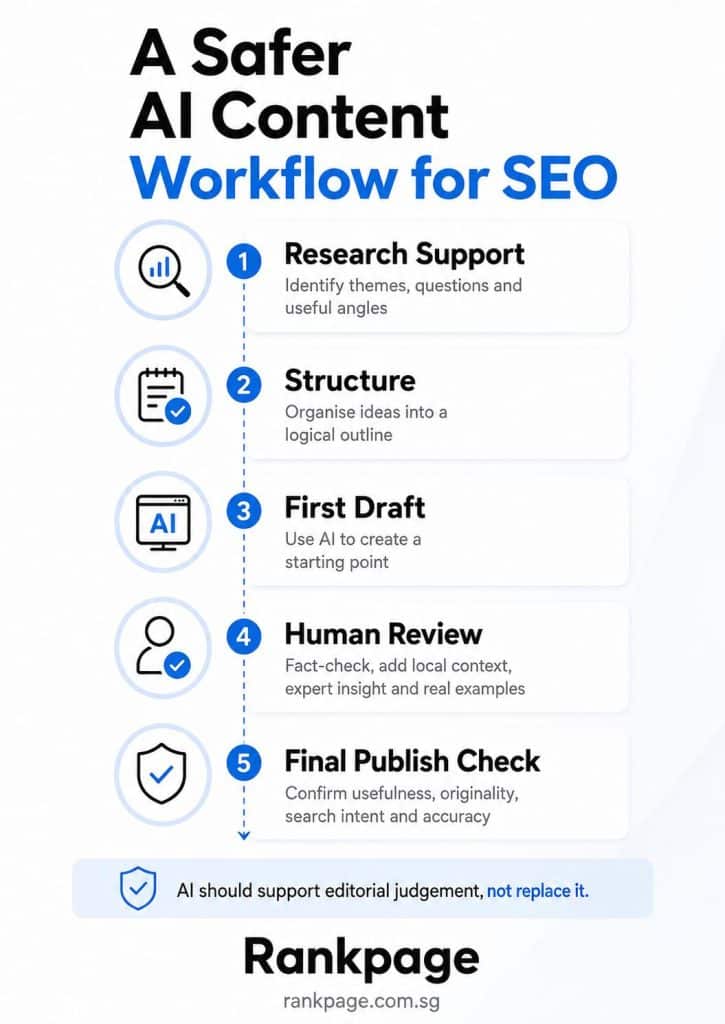
For most Singapore businesses, the better question is not whether to choose “AI content” or “human content”.
It is deciding what AI should handle and what humans should own.
We generally find AI useful for:
- Research support: Identifying themes, questions and angles.
- Structure: Turning scattered information into a logical outline.
- First drafts: Getting past the blank page.
- Editing support: Tightening awkward sections and reducing repetition.
- Content repurposing: Turning expert material into FAQs, summaries or other formats.
The process should not end there.
Claims still need verification. Examples still need substance. Local context still needs to be accurate. And somebody still needs to decide whether the page actually says anything useful.
What Must a Human Still Add?
The human layer is often where an ordinary AI draft becomes worth publishing.
A writer or subject expert can add observations from real campaigns, explain exceptions and recognise when technically correct information may be misleading in practice.
Consider these two sentences:
“Businesses should optimise content for search intent.”
Versus:
“We often find that a page fails not because it lacks keywords, but because the business is targeting an informational query with a service page that immediately tries to sell something.”
The first is correct.
The second gives the reader something they can diagnose.
AI can help organise that knowledge, but it should not invent the experience behind it.
How Does AI Content Affect E-E-A-T?
AI itself does not automatically strengthen or weaken the qualities Google associates with E-E-A-T.
Google describes E-E-A-T as experience, expertise, authoritativeness and trustworthiness, with trust being the most important of those qualities.
E-E-A-T itself is not a specific ranking factor. Google says its systems use a mix of signals that can identify content demonstrating these qualities.
AI can help an expert communicate more efficiently, but it cannot create genuine professional experience that does not exist.
For stronger E-E-A-T, focus on:
- Experience: Real examples, observations and first-hand lessons.
- Expertise: Accurate explanations reviewed by someone who understands the field.
- Authority: Clear authorship and supporting references.
- Trust: Transparent claims and accurate sourcing.
Google’s guidance for generative Search continues to emphasise foundational SEO and unique, helpful content rather than special optimisation tricks for AI results.
So, Should Singapore Businesses Publish AI Content?
Yes, but we would change the question slightly.
Instead of asking, “Can we publish AI content?”, ask:
“What is the AI doing that makes this content better?”
If the answer is simply “it lets us publish ten times faster”, that deserves scrutiny.
If AI helps your team spend less time formatting drafts and more time interviewing experts, analysing customer questions, checking Search Console and improving the final answer, it can be extremely useful.
For us, the stronger model in 2026 is not simply human versus AI.
It is good editorial judgement supported by AI versus mass-produced content with almost no editorial judgement at all.
Using AI Generated Content the Right Way
AI-written content can still rank in 2026, but being generated by AI is neither an advantage nor an automatic disadvantage.
The pages most likely to compete are still the ones that satisfy search intent, contribute something useful or original, demonstrate credible knowledge and give readers a reason to choose them over competing results.
At Rankpage, your trusted SEO marketing consultant in Singapore, we help businesses build content strategies that combine efficient AI-assisted workflows with the research, expertise and optimisation needed to compete in modern search. Our SEO services also help Singapore businesses strengthen visibility across traditional search and emerging AI-driven search experiences.
Sources
- Google Search Central, Google Search’s Guidance on Using Generative AI Content on Your Website.
- Google Search Central, Spam Policies for Google Web Search.
- Google Search Central, Creating Helpful, Reliable, People-First Content.
- Google Search Central, Optimizing Your Website for Generative AI Features on Google Search.
- Google Search Central, Top Ways to Ensure Your Content Performs Well in Google’s AI Experiences on Search.
- Google Search Central, Google Search’s Guidance About AI-Generated Content.