Why Isn’t My Content in AI Overviews?
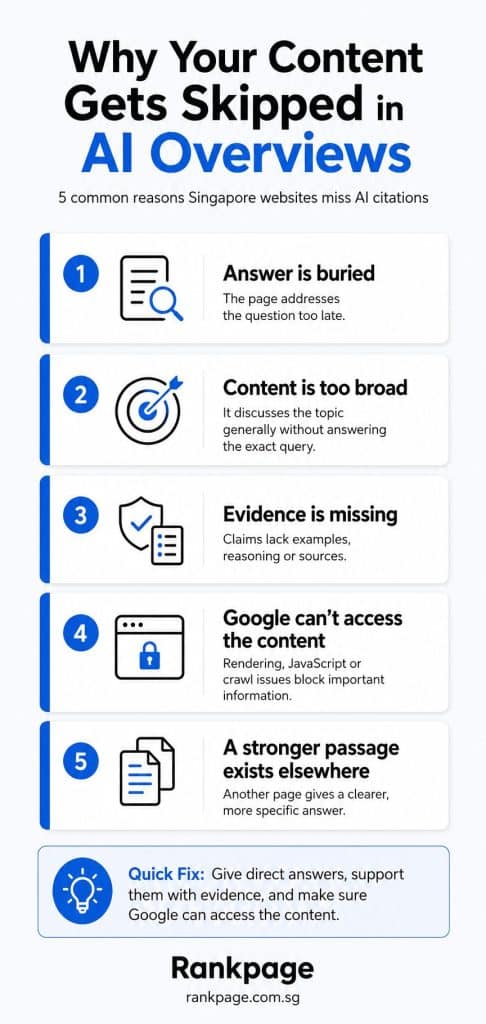
There is rarely one universal reason.
Google says the same core practices used for organic search also apply to its generative AI features. A page must be indexable, eligible to appear with a search snippet and compliant with Google’s technical requirements and policies. There is no special AI Overview markup that guarantees inclusion.
In practice, we commonly find several problems.
The answer is buried: The page addresses the question only after several introductory or promotional paragraphs.
The content is too broad: A general service page discusses SEO or digital marketing without directly answering a narrower question.
The passage lacks evidence: The page makes a recommendation without explaining why, giving an example or citing a source.
Google cannot access the content properly: JavaScript errors, blocked resources, interaction-dependent loading, canonical issues or crawling restrictions may prevent important content from being indexed.
A stronger passage exists elsewhere: A competitor may provide a clearer, more specific or better-supported answer.
This is why adding more content is not always the solution. A long article can still be less useful than a shorter page that gives precise answers.
Does Ranking #1 Guarantee an AI Citation?
No. A number-one organic ranking does not guarantee inclusion in Google AI Overviews.
A March 2026 Ahrefs analysis of approximately 863,000 keyword search results pages found that 38% of pages cited in AI Overviews also ranked in the top 10 for the same query.
A separate 2026 academic preprint found that almost 30% of AI-cited domains did not appear among the conventional first-page results shown alongside the AI Overview.
Rankings Are Not Irrelevant
This does not make rankings irrelevant. Strong organic visibility can still indicate that Google can crawl and understand your content.
However, AI Overviews may use related searches to find supporting information for different parts of a question. A page that does not rank first for the main keyword may still provide the clearest answer to one sub-question.
For example, a Singapore accounting guide may earn a citation if it clearly explains filing requirements, deadlines, record-keeping and when professional advice may be needed.
Think of organic search as page-level competition. For AI visibility, individual sections also matter.
What Structure Does AI Extraction Need?
There is no content structure that guarantees an AI Overview citation.
However, clear organisation makes content easier for readers and search systems to understand.
A useful section often follows this sequence:
Content Element | Purpose |
Question-based heading | Identify the exact problem |
Direct opening sentence | Give the answer immediately |
Supporting explanation | Explain the reasoning |
Evidence or example | Make the claim useful and credible |
Relevant next step | Help the reader act |
Suppose an article asks, “What Is the Best SEO Strategy?”
A vague answer might say every business is different and needs a customised solution.
A stronger answer would say:
The best AI SEO service strategy for most Singapore SMEs combines technically accessible pages, commercially relevant content and credible supporting evidence. The exact priority depends on whether the website’s main constraint is indexing, relevance, competition or conversion.
The second version is more useful because it names the main components and gives clear decision criteria.
Use descriptive headings, short paragraphs and logical internal links. Important information should appear in the rendered HTML that Google receives.
Avoid implementations that require Googlebot to submit a form, click a control or perform another interaction before content loads. Tabs and accordions are generally fine when the content is already present and indexable.
Is My Content Too Vague for AI?
Possibly. Vagueness is one of the most common issues we identify when auditing useful-looking content that is not being cited.
Many business websites contain polished statements that provide little usable detail:
- We deliver innovative solutions.
- Our experienced team provides personalised support.
- Businesses should select the right strategy.
- Results vary depending on several factors.
These statements are not necessarily false. The problem is that they do not explain anything specific.
Instead of saying SEO results vary, explain that timelines depend on the website’s technical condition, existing authority, competition, content coverage and approval speed.
Instead of telling companies to choose the right payroll provider, explain that Singapore employers should compare CPF submission support, statutory reporting, data security, integrations and response times.
Specificity usually comes from:
- Defined criteria: Explain how a decision should be made.
- Local context: Include Singapore regulations, terminology or market conditions.
- Original experience: Add recurring issues observed through audits or campaigns.
- Current evidence: Support claims with credible sources or internal data.
- Practical examples: Show how the advice works in a realistic situation.
Google also warns that publishing large volumes of generative AI content without adding value may violate its scaled content abuse policy.
The issue is not whether AI helped produce the draft. It is whether the final page adds something useful, reliable and distinctive.
Do I Need Schema?
Use appropriate structured data where it accurately represents the page, but schema cannot guarantee an AI Overview citation.
Depending on the page, relevant markup may include Organization, LocalBusiness, Article, Product or Breadcrumb.
Google does not identify any special AI Overview schema. It also says structured data should match information visible on the page.
That means adding FAQ markup to a weak article will not make its answers useful. Marking up an author does not establish expertise when the page contains no original insight.
Use schema as a reinforcement layer:
Content first: Write a precise and helpful answer.
Entity clarity second: Make the organisation, author, service and topic clear.
Markup third: Add valid structured data that reflects the visible content.
Also confirm that the page is indexable, correctly canonicalised, usable on mobile devices and discoverable through internal links. Important explanations should not appear only inside images.
How Do I Test and Fix It?
Start with diagnosis, not rewriting.
Google introduced dedicated generative AI performance reporting in Search Console in June 2026, giving site owners more visibility into impressions from AI Overviews and AI Mode.
Use this six-step process:
- Build a query set: Test the main keyword, question variations, comparisons and Singapore-specific searches.
- Record the citations: Note which pages appear and whether sources change across similar searches.
- Compare answer quality: Look for definitions, numbers, conditions, examples and clearer wording that your page lacks.
- Improve the relevant passage: Strengthen the section that should answer the query instead of rewriting the entire page.
- Check technical access: Review indexing, rendering, canonical signals, internal links, structured data and mobile presentation.
- Retest over time: AI Overviews are dynamic, so one successful or unsuccessful search is not conclusive.
Featured snippets may also provide useful clues. If your page cannot answer a straightforward query clearly enough for a featured snippet, its wording may still be too indirect.
However, featured snippets and AI Overviews are separate features, so performance in one does not guarantee performance in the other.
Diagnosing Your Content
Content may be excluded from Google AI Overviews for several fixable reasons. The strongest answer may be buried, vague, unsupported or technically difficult for Google to access.
Treat AI search visibility as a diagnostic exercise. Identify the query, study the cited pages, strengthen the missing information and remove technical barriers.
Rankpage helps Singapore businesses improve organic rankings and visibility across evolving AI search experiences. As a SEO consultant in Singapore, our services combine technical optimisation, content strategy and authority building to help your website become a more useful and credible source.