What Is Answer-First Writing?
Answer-first writing is a structure where each section begins with a direct response to the question in its heading.
The basic pattern is:
- Question-based heading
- Direct answer
- Explanation
- Example or evidence
For example, instead of spending several paragraphs discussing recruitment trends before answering how long hiring takes, the section could begin with:
Hiring in Singapore may take several weeks, depending on the role, talent supply and number of interview stages.
The rest of the section can then explain why timelines vary and how employers can reduce delays.
This approach creates a clear link between the question and the response. However, answer-first formatting is not a separate Google ranking factor and does not guarantee selection by a search or AI system.
Answer-first also does not mean answer-only. A short paragraph without evidence, originality or useful detail is unlikely to be the most useful result.
How Do I Structure a Page for Featured Snippets?
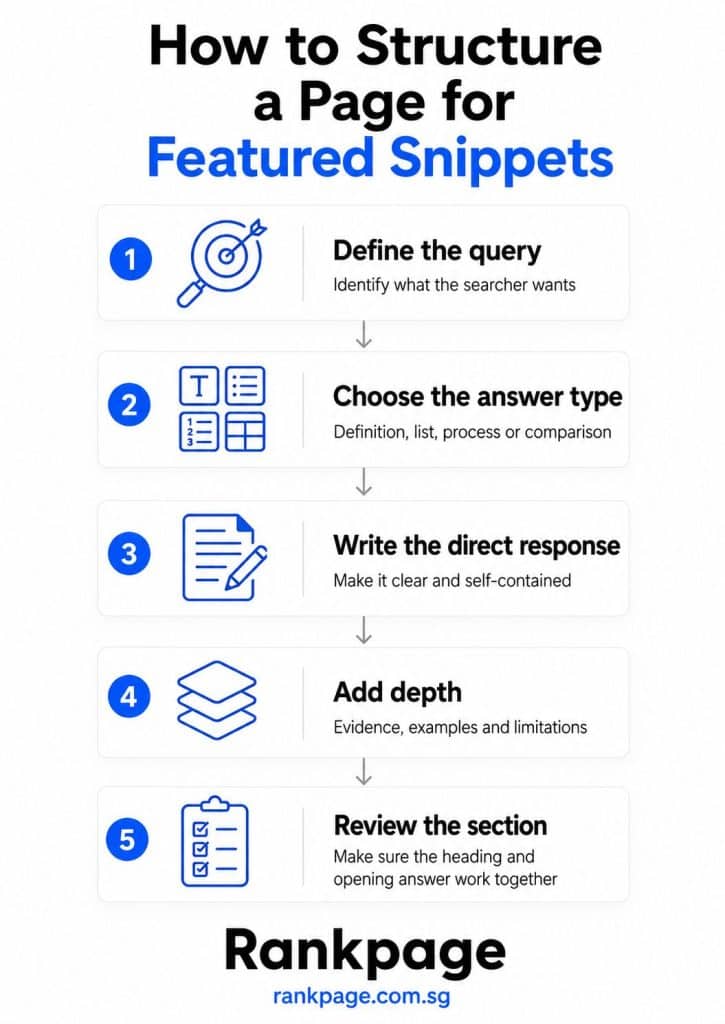
To target featured snippets, identify the exact question, place a concise response under a closely matched heading and use a format that suits the information.
Google selects featured snippets automatically, so no page structure can guarantee an appearance. The aim is to make the answer clear, complete and easy to interpret.
Page Element | Recommended Approach | Common Mistake |
Introduction | Answer the main query early | Spending too long setting the scene |
H2 headings | Use natural questions where suitable | Using vague headings such as “Overview” |
Opening answer | Give a self-contained response | Starting with filler or broad context |
Supporting copy | Add examples and evidence | Repeating the same answer |
Formatting | Match the search intent | Forcing every section into bullets |
A practical workflow is:
- Define the query: Work out what the searcher actually wants.
- Choose the answer type: Decide whether the response needs a definition, process, list or comparison.
- Write the direct response: Make sure it can stand on its own.
- Add depth: Support it with examples, evidence and limitations.
- Review the section: Check whether the heading and opening paragraph form a complete answer.
Many pages contain the right information but bury it halfway through the section. Moving the answer closer to the heading can improve clarity without changing the core message.
Read More: Schema Markup: How Singapore Websites Can Win Featured Snippets and AI Search Citations
How Should I Format Lists, Tables and Q&A Content?
Search and AI systems can interpret paragraphs, lists, tables and Q&A sections, although results vary by platform and query.
Choose the format that communicates the information most clearly:
- Short paragraphs: Useful for definitions and direct explanations.
- Numbered steps: Useful for processes that follow a sequence.
- Bulleted points: Useful for options, warning signs or benefits.
- Tables: Useful for comparisons across consistent criteria.
- Q&A sections: Useful for focused follow-up questions.
These are editorial guidelines rather than guaranteed extraction rules.
For important sections, we often use three layers:
Layer | Purpose |
Direct answer | Resolves the main question |
Supporting explanation | Adds context and qualifications |
Proof or example | Demonstrates experience and usefulness |
This gives readers a clear answer while allowing the page to provide enough depth.
Where Should the Answer Go on the Page?
The main answer should appear near the beginning of the page. Secondary answers should appear directly below the heading that introduces each question.
For the main topic, place the answer in the opening paragraph. Readers should not have to scroll past a long brand story or market overview before learning what the page says.
For individual sections, use this pattern:
Question-Based Heading
Give the direct answer in the first one or two sentences.
Then add supporting details, examples, exceptions and practical advice.
Compare these openings:
Weak: There are several factors businesses should consider when deciding whether to hire an SEO agency.
Stronger: A Singapore business should consider hiring an SEO agency when organic search is important but the internal team lacks the time or expertise to execute consistently.
The second version answers the question immediately and leaves room for deeper explanation.
How Do FAQs Help AEO?
FAQs can support AEO and answer-focused content by addressing specific follow-up questions in a clear, self-contained format.
They are useful when keyword research, Search Console data or customer conversations reveal questions that are too narrow for full sections.
A strong FAQ should:
- Answer one question: Avoid combining unrelated topics.
- Begin directly: Give the response before the explanation.
- Add new value: Do not copy a paragraph from the article.
- Stay concise: Include enough context without creating another full section.
- Reflect real demand: Focus on questions customers genuinely ask.
Valid structured data can give search engines explicit information about a page, but it does not guarantee rankings, rich results or AI citations. Google does not require special structured data for its AI features, and FAQ rich-result visibility is restricted.
For most Singapore businesses, the main benefit of a useful FAQ section is clearer topical coverage and a better reader experience.
Read More: How to Optimise Your Singapore Website Content for AI-Generated Search Results
How Do I Measure Snippet Wins?
Measure snippet performance by combining manual or third-party tracking with search visibility, user behaviour and commercial outcomes.
Measurement | What It Shows |
Featured-snippet tracking | Whether a page appears in the featured position |
Search impressions | Whether visibility is growing |
Click-through rate | Whether users continue to the website |
Platform-reported AI citations | Where supported, whether pages are referenced |
Engagement | Whether visitors continue reading |
Conversions | Whether the traffic produces enquiries |
Google Search Console reports impressions, clicks, click-through rate and average position, but it does not provide a dedicated featured-snippet ownership metric. Snippet ownership may need to be checked manually or through a third-party tracking platform.
AI reporting also varies. Bing Webmaster Tools introduced AI Performance reporting in public preview in February 2026, including citations, cited pages and grounding queries. Equivalent citation-level data is not available across every platform.
Start with a defined group of questions. Record which page currently ranks, what format appears and which section targets the query. Then review performance over time.
Do not treat every mention as equally valuable. A broad informational citation may improve awareness, while a snippet for “SEO agency cost Singapore” may be closer to a buying decision.
What Should Singapore Businesses Avoid?
The main mistake is turning answer-first writing into a rigid formula.
Common issues include:
- Over-compression: The page gives a short answer but no evidence or practical detail.
- Question overload: Every heading is forced into a question.
- Format stuffing: Tables and bullets are added purely because they appear machine-friendly.
- Generic expertise: The article explains what to do without showing how or why.
- Artificial repetition: The same answer appears in the introduction, body and FAQ.
- Unsupported guarantees: The page promises featured snippets or AI citations.
The goal is not simply to state the answer first. It is to provide the clearest and most useful answer available.
Using Answer-First Content the Right Way
Answer-first content makes important information easier to find, understand and reuse. Start with a direct response, match the format to the query and support it with evidence, examples and real experience.
No structure can guarantee a featured snippet, ranking or AI citation. However, clear writing, useful information and strong SEO fundamentals can improve how effectively a page serves readers.
At Rankpage, the best SEO agency in Singapore, we structure content for both human readers and evolving search experiences. Our SEO services can help Singapore businesses improve existing pages for clearer answers, featured snippet eligibility and stronger organic visibility.
Sources
- Google Search Central, “Featured Snippets and Your Website”
- Google Search Central, “AI Features and Your Website”
- Google Search Central, “Creating Helpful, Reliable, People-First Content”
- Google Search Central, “Introduction to Structured Data Markup”
- Google Search Central, “Control Your Snippets in Search Results”
- Google Search Console Help, “What Are Impressions, Position and Clicks?”
- Bing Webmaster Tools, “Introducing AI Performance in Bing Webmaster Tools”